
Pump Materials Compared: Cast Iron, Bronze, Stainless Steel and Engineered Plastic
The fluid decides the material, not the price list.
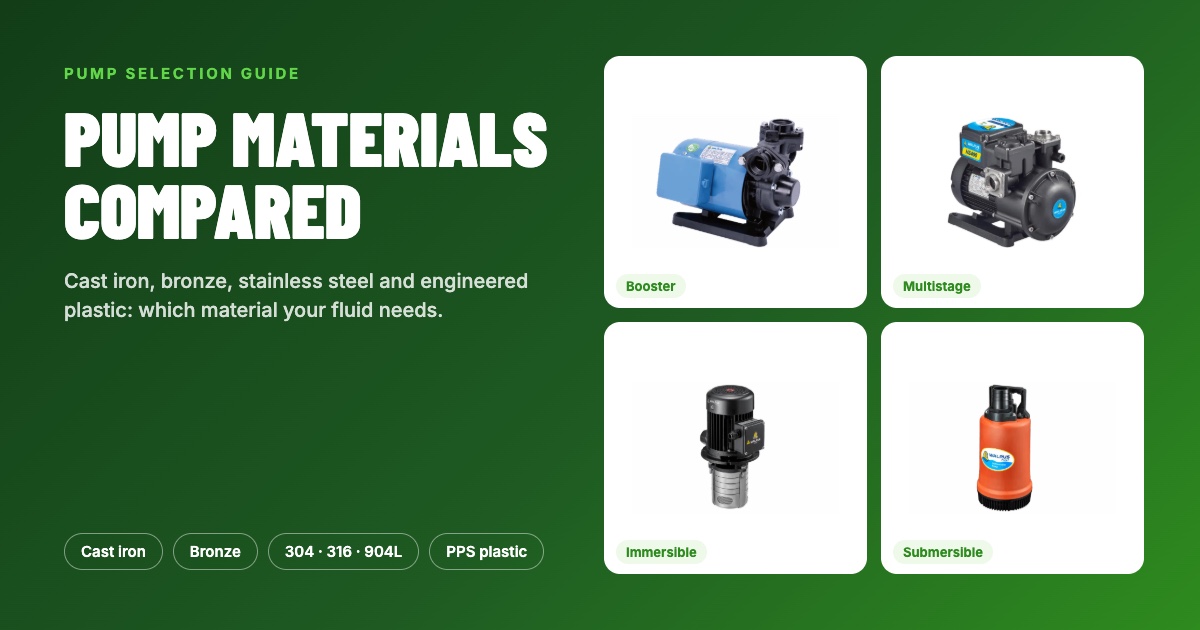
This guide compares the six materials you will meet on pump casings and impellers: what each survives, where each fails, and which WALRUS pump series in the Valvenok range uses it.
Pump materials comparison table
Compare the wetted-part materials side by side. PREN (Pitting Resistance Equivalent Number = %Cr + 3.3×%Mo + 16×%N) applies to stainless grades only; higher means harder to pit in chloride water.
| Material | ||||||
|---|---|---|---|---|---|---|
| Typical use in a pump | Casings, diffusers, valve housings | Impellers, wear rings, marine casings | Impellers, shafts, casings on light-duty pumps | All wetted parts | All wetted parts, aggressive duty | Casings, covers on compact pumps |
| Corrosion behaviour | No passive film; rusts and graphitises in soft, acidic or saline water | Good in seawater; low-zinc grades resist dezincification | Passive chromium-oxide film; pits in chloride water | Molybdenum lifts pitting resistance for moderate chloride | High Ni and Mo; resists chloride pitting and reducing acids | Does not rust or pit; chemically inert to most water |
| PREN | — | — | ≈ 19 | ≈ 26 | ≈ 35 | — |
| Abrasion / shock | Excellent | Good | Good | Good | Good | Low |
| Relative cost | ££££(lowest) | ££££ | ££££ | ££££ | ££££ | ££££ |
| Best for | Dewatering, irrigation, municipal fresh water, closed heating circuits | Marine cooling, seawater transfer, fire-fighting | Clean fresh water, potable supply, boosting | Food, pharma, treated water, moderate chlorides | Seawater intake, brackish dewatering, mine water | Domestic and light-commercial clean water boosting |
| Avoid in | Seawater, brackish water, potable lines needing clean water | Ammonia-bearing fluids, high-velocity sand slurry | Coastal, brackish or chlorinated pool water | Continuous seawater, high-chloride warm water | Duties where 316 already lasts — it rarely pays back | Abrasive solids, high pressure, impact-prone sites |
How the materials score
Indicative ratings out of 5, for comparison only. Your fluid analysis overrides any chart.
Stainless grades by PREN: the chloride number that matters
What the WALRUS range uses, and why
Four series from the Valvenok pump range show the trade-offs above in real products. Figures are from each series' product page.
- Casing
- PPS
- Impeller
- SUS304
- Shaft
- SUS410
- Seal
- Ceramic + carbon + NBR
- Liquid temp.
- +4 to +40 °C
- Wetted parts
- Corrosion-resistant materials
- Fluid
- TS: plain and salt water
- System pressure
- Max. 8.5 kg/cm²
- Liquid temp.
- +4 to +40 °C
- Main parts
- Stainless steel
- Fluid
- Water, coolant, light oil
- Seal options
- SiC, carbon; HNBR / Viton / EPDM
- Liquid temp.
- 0 to +90 °C
- Construction
- Corrosion-resistant, IP68
- Saltwater
- R-coded models
- Flow
- Up to 440 L/min
- Liquid temp.
- +4 to +35 °C
Choose in four questions
- What is in the fluid? Get chloride, pH and solids figures. Chloride rules out cast iron and pushes stainless up the PREN scale.
- How hot does it run? Many compact boosters are rated to 40 °C; hot-water and immersible series go to 90 °C.
- Is there grit or shock? Sand and water hammer favour cast iron's wall mass over thin stainless or plastic.
- What does a failure cost? Where retrieval or downtime is expensive, pay for the higher grade up front.
Frequently asked questions
Is a stainless steel pump better than cast iron?
What is the best pump material for seawater?
Are plastic pump casings reliable?
Does the seal material matter as much as the casing?
Match the pump to your fluid
Eight WALRUS pump families, 50/60 Hz, up to 267 m head and 650 L/min. Send us your fluid, temperature and duty point.