
Track Order
Quick Order
Cart
Sign In
Seaflex seals prevent fluid leakage across pressures from vacuum to 140 Bar and -60°C to 350°C.
35+ seal types cover every application from clean water pumps to pharmaceutical reactors.
Material selection — rubber bellow, PTFE, or metal bellow — is as critical as seal type.
Cartridge seals reduce installation errors and cut shutdown time dramatically.
Correct API flush plans are essential for maximising seal life in demanding service.
Ever wondered what keeps industrial systems running smoothly without leaking a drop? The unsung hero is the mechanical seal. From water pumps to pharmaceutical reactors and oil refineries, Sealflex mechanical seals from Valvenok are the precision components that prevent leaks, protect equipment, and keep operations running. So, what makes them so essential — and how do they perform under pressures up to 140 Bar and temperatures from -60°C to 350°C?
Seaflex mechanical seals from Valvenok serve as the precision barrier between process fluid and the outside world. They prevent leaks that could cause production losses, safety incidents, or environmental violations — and they do it reliably across some of the most demanding conditions in industry. Whether it's a rubber bellow seal on a water treatment pump or a double agitator seal on a hazardous chemical reactor, the right seal keeps operations safe, clean, and efficient.
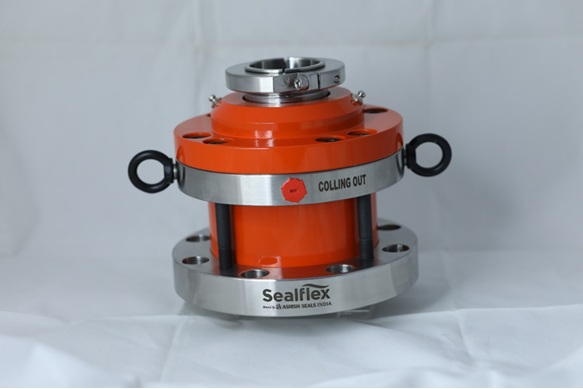
A failed seal means unplanned downtime — and in industrial settings, that cost is almost always far greater than the seal itself. Beyond the repair bill, there is lost production, potential product contamination, environmental clean-up, and in serious cases, regulatory consequences. This is why engineers specify Seaflex seals with pressure ratings matched to the maximum credible operating condition — not just the normal operating point.
| COMPONENT | STANDARD MATERIALS | HIGH-PERFORMANCE OPTIONS |
|---|---|---|
| Seal Faces | Carbon, Ceramic | Silicon Carbide, Tungsten Carbide |
| Secondary Seals | Nitrile, Neoprene | Viton®, EPDM, PTFE, Silicone |
| Hardware | SS 304 | SS 316, Alloy 20, Hastelloy-C |
| Springs | SS 304 | SS 316 |
The right material combination is as important as the seal type. Viton O-rings handle petroleum and chemicals to 200°C; PTFE bellows resist virtually all acids and solvents; and welded metal bellows (BS14) push capability to 350°C where no elastomer can survive.
Two precision-lapped faces — one rotating, one stationary — are held in controlled contact by spring force and system pressure. A microscopic fluid film between them provides lubrication while forming the seal. The spring keeps the faces together during low-pressure start-up; as system pressure rises, it adds to the closing force. The result is a self-adjusting seal that delivers near-zero leakage across a wide operating range.
Heat generated by face friction is the key engineering challenge. The PV value — contact pressure multiplied by sliding velocity — governs heat generation. Silicon carbide face materials, correct spring loading, and the right API flush plan keep the PV value within safe limits, ensuring long service life even at speeds up to 4,500 RPM.
The most widely used general-purpose seal. Operating up to 4,500 RPM, 12 Bar, and 180°C across shaft diameters from 12–100 mm. Tolerant of crystallising fluids thanks to the bellow design. Used in water treatment, pharmaceuticals, power generation, and pulp and paper.
The multi spring seal PS36 is the Seaflex workhorse for high-pressure duty — rated to 35 Bar and -60°C to 200°C, ideal for petrochemical, chemical, and refinery service. The wave spring PS40 suits slurry and chemical applications to 180°C. The bi-direction PS34 handles applications with shaft rotation in both directions, rated to 14 Bar and 200°C.
For corrosive duty, the PTFE bellow seal BS13 is chemically inert to virtually all acids, alkalis, and solvents. For high-temperature service, the metal bellow seal BS14 eliminates all elastomers, enabling reliable operation to 350°C in petroleum refineries and petrochemical plants.
Pre-assembled and pre-set at the factory, cartridge seals eliminate installation error — the leading cause of premature seal failure. Rated to 15 Bar and 220°C for slurry, pulp and paper, and food processing. The double cartridge CS53 adds a pressurised barrier fluid between two face sets, providing ultimate protection for hazardous or toxic process fluids.
Purpose-built for vertical shaft mixing equipment — reactors, blenders, and process vessels. The range spans from the single agitator AS91 (vacuum to 20 Bar, 180°C) and double agitator AS92N (vacuum to 10 Bar, 250°C) to the high-pressure AS97 (vacuum to 35 Bar, 250°C). Specialised variants include the ANFD reactor seal AS103, glass-lined reactor double seal AS105, and the dry running seal DS71 for zero-contamination food and pharmaceutical service.
The right seal starts with answering five key questions: What fluid are you sealing? What is the maximum pressure — including spikes? What is the temperature range? What is the shaft diameter and speed? And are there regulatory requirements (food-grade, zero-emission, pharmaceutical)?
Rubber Bellow BS11 (up to 12 Bar, 180°C)
PTFE Bellow BS13
Multi Spring PS36 (up to 35 Bar, 200°C)
Metal Bellow BS14
Cartridge CS52 or CS53
Agitator Series AS91 / AS92N / AS97
Boiler Feed Cartridge PS38
Dry Running Seal DS71
And don't overlook the flush plan. API plans such as Plan 11 (recirculation for clean fluids), Plan 23 (cooled recirculation for hot applications), Plan 32 (external clean flush for abrasive fluids), and Plan 53A (pressurised barrier for double seals on hazardous fluids) are essential for maximising Seaflex seal life in demanding service.
Most premature seal failures trace back to installation errors — not seal defects. Clean the shaft and housing thoroughly, handle seal faces without touching the lapped surfaces, lubricate O-rings with a compatible grease, and never start the pump without fluid prime or flush supply. For cartridge seals, installation is even simpler: slide on, bolt down, remove the setting clips — done.
Visible weeping at the gland — act promptly before it becomes a flood.
Elevated gland temperature — check flush flow immediately; may indicate dry running.
Increased vibration or noise — check shaft alignment and bearing condition.
Rapid face wear on removed seals — indicates abrasive contamination or incorrect materials.
Weekly visual checks, monthly flush system verification, and quarterly vibration analysis keep small problems from becoming big ones. Stock critical spare seals for essential equipment — the cost of holding a spare is a fraction of an unplanned shutdown. And for double agitator and double cartridge seals, the Valvenok Thermosyphon Pot System (TSP100) keeps barrier fluid circulating, cooled, and clean, extending seal life significantly in refinery, chemical, and petrochemical service.
Seaflex mechanical seals from Valvenok are the reliability foundation of pumps, agitators, reactors, and rotating equipment across industry worldwide. With over 35 configurations covering pressures from vacuum to 140 Bar, temperatures from -60°C to 350°C, and shaft sizes from 12 mm to 200 mm, there is a Seaflex seal for every application. Select the right type, specify the right materials, install it correctly, and support it with the right flush plan — and your Seaflex seal will deliver years of leak-free, reliable performance.
The Seaflex range spans rubber bellow seals (BS11 — general water and chemical service), spring seals (PS36 multi spring, PS40 wave spring, PS34 bi-direction), PTFE bellow seals (BS13 — corrosive service), metal bellow seals (BS14 — high-temperature petroleum), cartridge seals (CS52 single, CS53 double — fast installation), dry running seals (DS71 — food and pharma), and agitator seals (AS91 through AS105 — reactors and mixing vessels). Each is engineered for a defined range of pressure, temperature, and fluid conditions.
A single cartridge seal (CS52) provides one set of precision faces sealing the process fluid from atmosphere. A double cartridge seal (CS53) adds a second face set with pressurised barrier fluid between them — so even if the inboard seal fails, process fluid cannot escape. Double cartridge seals are required for toxic, hazardous, or high-value fluids.
Under correct operating conditions with the right flush plan, Seaflex seals are designed for service life measured in years. The main causes of shortened life are dry running, installation errors, shaft misalignment, incorrect material selection, and operation outside rated limits. For critical applications, Valvenok recommends planned replacement at every major shutdown rather than running to failure.
Traditional gland packing is designed to leak slightly — it must, to lubricate the shaft. Seaflex mechanical seals achieve near-zero leakage through precision face contact, eliminating product waste, shaft wear, and ongoing leakage that creates housekeeping and compliance problems. The payback on upgrading from packing to a Seaflex mechanical seal is typically very rapid.
Seaflex mechanical seals achieve near-zero leakage, eliminating product waste and shaft wear. The payback on upgrading from packing to a Seaflex mechanical seal is typically very rapid.