

L-Port vs T-Port 3-Way Ball Valves: Flow Paths, Applications and How to Specify
Every flow position for both bore types, which one suits diverting, mixing and bypass, and what to put in your enquiry.
A 3-way ball valve does the job of two or three 2-way valves in a single body. The decision that matters most is the shape of the hole through the ball: L-port or T-port. Get it wrong and the valve will not isolate when you need it to, or it will dead-head a pump during changeover. This guide shows every flow position for both types, explains which one suits diverting, mixing and bypass duties, and lists what to include in your enquiry so the quote comes back right the first time.
Key takeaways
- An L-port connects the common port to one side port at a time. It can also offer a full off position.
- A T-port can connect all three ports, pass flow straight through, or divert. It can never shut off fully.
- Diverting with isolation: choose an L-port. Mixing, bypass, or switching without interrupting flow: choose a T-port.
- Always state the flow pattern for each position, the seat design, end connections and actuation in your enquiry.
- 3-way valves need more operating torque than 2-way valves, so size the actuator from the manufacturer’s figures.
What is a 3-way ball valve?
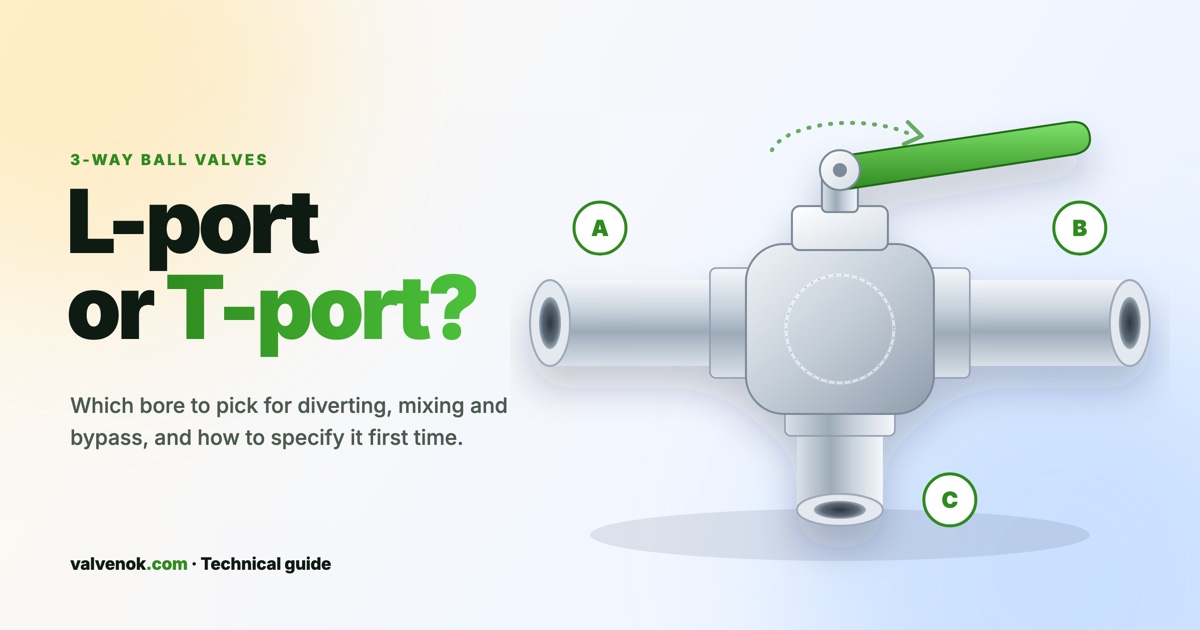
A 3-way ball valve has three ports and a ball drilled with a bore that links two or three of them, depending on which way the ball is turned. In this guide the two side ports are labelled A and B, and the common (centre) port is C. Turning the stem a quarter or half turn changes which ports are connected. That lets one valve divert, select, mix or bypass flow without extra pipework or a second valve.
The body and seats look much the same whichever bore you choose. The bore shape decides what the valve can do. This is why “3-way ball valve” on its own is not enough information to quote from.
L-port flow paths
The L-port ball has two openings set at 90° to each other. In every working position it connects the common port C to one side port, and the other side port is sealed off. A quarter turn swings the flow from A to B.
Some L-port valves are built with 180° travel or adjustable stops. These can be turned to a third position where the bore faces the body wall and no ports are connected, so the valve isolates as well as diverts. Whether this off position exists depends on the stop configuration, so confirm it at enquiry stage.
T-port flow paths
The T-port ball has a straight bore with a branch drilled into it, which gives three openings. That adds two positions an L-port cannot offer: all three ports connected at once, and straight-through flow from A to B with C closed.
The trade-off is that a T-port always has a flow path. No position closes all three ports. That is a good thing on pump discharge, where you never want the line dead-headed during changeover. It is a problem if operators expect the valve to isolate.
L-port vs T-port at a glance
| Feature | L-port | T-port |
|---|---|---|
| Bore shape | Two openings at 90° | Three openings (through bore plus branch) |
| Connects all three ports at once | No | Yes (position 1) |
| Straight-through flow A ↔ B | No | Yes (position 2) |
| Full shut-off position | Yes, if the stops allow the off position | No, there is always a flow path |
| Typical travel | 90° (two-way divert) or 180° with off | 90° or 180°, depending on the pattern |
| Best for | Diverting or selecting, where one outlet must be fully isolated | Mixing, bypass, and switching without dead-heading a pump |
| Watch out for | Flow is restricted while the ball is mid-travel | Cannot isolate the line; check seat design for leakage between ports |
When to use each: diverting, mixing and bypass
Diverting (one inlet, two outlets)
Flow comes in at C and is sent to either A or B. L-port is the usual choice, because the outlet not in use is fully sealed. A T-port works too, using positions 3 and 4, and passes flow to both outlets while it moves between them.
- Switching between duty and standby tanks or vessels
- Changing over duplex filters or strainers without shutting down
- Sending product to a process line or back to the tank (recirculation)
- Selecting a sample point or drain
Mixing or selecting (two inlets, one outlet)
To select one of two sources, such as two supply tanks or mains water and a backup, an L-port does the job and keeps the source not in use isolated. To combine two streams, use a T-port in position 1 with all three ports open. A ball valve gives on/off blending, not accurate proportioning. For temperature or ratio control, specify a 3-way control valve or a characterised ball valve with a modulating actuator.
Bypass
This is where the T-port comes into its own. In position 2, flow runs straight from A to B and bypasses whatever is connected to C. Turn the valve and the flow is routed through C instead. Because the line is never fully closed, a pump upstream keeps a flow path throughout the changeover.
- Bypassing a heat exchanger, cooler or heater during start-up or maintenance
- Flow meter or instrument bypass, so the meter can be removed with the line still running
- Filter bypass for cleaning without shutting down
- Pump discharge changeover, where dead-heading must be avoided
How to specify a 3-way ball valve
Most quotes for 3-way valves go back and forth because the enquiry leaves out details. Work through these seven points and you will get a like-for-like price first time.
- Screwed: BSPP, BSPT or NPT. State which, because they do not seal against each other.
- Flanged: EN 1092-1 (PN) or ASME B16.5 (Class), with facing type (RF/RTJ).
- Socket weld or butt weld: give the schedule and pipe standard.
- Tri-clamp or hygienic: for food, beverage and pharmaceutical lines.
Enquiry checklist
Common specification mistakes
- Expecting a T-port to isolate. It cannot. Fit a separate isolation valve or use an L-port with an off position.
- Ordering “3-way, T-port” without the flow pattern. Two T-port valves can have different patterns, so always send the sketch.
- Undersizing the actuator. 3-way valves have higher breakaway torque, which increases further after long periods without operation.
- Mixing BSP and NPT. The threads look similar but will not seal reliably together.
- Using a ball valve for modulating control. Use a control valve or a characterised ball valve instead.
Frequently asked questions
Can an L-port valve be used for mixing?
Can a T-port 3-way ball valve shut off flow completely?
Is a 3-way ball valve suitable for temperature or ratio control?
Do 3-way ball valves need a bigger actuator?
What is the difference between side-entry and bottom-entry 3-way valves?
Need a 3-way ball valve specified?
Send us your flow pattern sketch and duty conditions. We will match the valve, seats and actuation and come back with a quote.