

Safety Valve vs Relief Valve: How They Work and How to Choose
How each type works, the terms on a datasheet, sizing and installation basics, and the UK rules that apply.
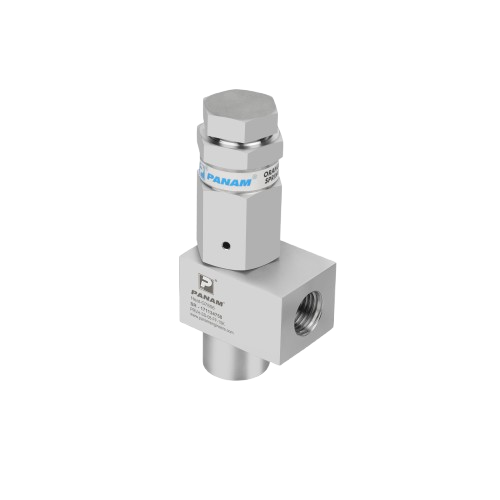
A safety valve opens fully and almost instantly when pressure reaches its set point, so it can release gas, steam or air fast. A relief valve opens gradually, in proportion to how far pressure rises above the set point, which suits liquids. Both are pressure relief valves: automatic devices that stop pressure rising to a level that could damage equipment or hurt people. This guide explains how each type works, the terms you will see on a datasheet, the basics of sizing and installation, and the UK rules that apply.
Key takeaways
- A safety valve pops fully open at its set pressure. It is used on gas, steam and air.
- A relief valve opens gradually, in proportion to the overpressure. It is used on liquids.
- A safety relief valve can work either way, depending on the service.
- The set pressure must not exceed the MAWP of the equipment it protects.
- In the UK, safety valves are part of the written scheme of examination under PSSR 2000.
Safety valve vs relief valve at a glance
| Safety valve | Relief valve | Safety relief valve | |
|---|---|---|---|
| Opening action | Pops open to full lift | Opens gradually, in proportion to overpressure | Either, depending on the service |
| Typical fluid | Steam, gas, air | Liquids | Gases or liquids |
| Typical use | Boilers, air receivers, compressors, gas vessels | Pumps, hydraulic systems, liquid-filled lines | Process vessels with mixed duties |
| Main concern | Releasing large gas volumes fast | Avoiding sudden pressure surges in liquids | Covering both duties with one valve |
A rupture disc is a different device: a thin membrane that bursts at a set pressure and does not reclose. It is often fitted upstream of a relief valve to protect the valve from the process fluid.
How a safety valve works
Most safety and relief valves are spring-loaded. A spring holds a disc against the seat, and process pressure pushes up on the disc.
A relief valve has no huddling chamber effect, so the disc lifts steadily as pressure rises. That gentler action avoids pressure surges in liquids, which cannot expand like gases.
Key terms on a safety valve datasheet
| Term | Meaning |
|---|---|
| Set pressure | The pressure at which the valve starts to open |
| Overpressure | Pressure rise above set pressure, as a %. Commonly 10% for pressure vessels, but check the code that applies |
| Accumulation | Pressure rise above the equipment’s maximum allowable working pressure (MAWP) during relief |
| Blowdown | Difference between set pressure and reseating pressure, as a % of set pressure |
| Back pressure | Pressure at the valve outlet. Built-up back pressure comes from the discharge flow itself |
| Relieving capacity | The flow the valve can pass at the stated overpressure |
| Orifice | The flow area. Flanged process valves use standard letter sizes (D to T) under API 526 |
| Cold differential test pressure | The bench set pressure, adjusted for temperature and back pressure |
Types of pressure relief device
- Conventional spring-loaded safety valves: the standard choice where back pressure is low.
- Balanced bellows valves: a bellows shields the disc from back pressure, so they work with higher or variable back pressure.
- Pilot-operated valves: a small pilot valve controls a larger main valve. They hold tight closer to set pressure and suit large flows and high back pressure.
- Proportional relief valves: open gradually; common on hydraulic and instrument lines.
- Thermal relief valves: small relief valves that protect liquid trapped between closed valves from thermal expansion.
- Rupture discs: non-reclosing; used alone or with a relief valve.
- Thermally activated relief devices: fusible or glass-bulb devices that vent a gas cylinder in a fire, as on many hydrogen cylinder valves.
See our safety and relief valve range for instrumentation relief valves, high-pressure relief valves, rupture discs and thermal relief devices from our partner brands.
Sizing basics
Sizing is a job for a competent engineer, normally to API 520 or ISO 4126. The steps are:
Installation rules that prevent failures
- Keep the inlet short. A common guideline (API 520 Part II) is to keep inlet pressure loss below 3% of set pressure. Higher losses cause chatter.
- Do not isolate it in service. If a block valve sits under a safety valve, it must be locked or car-sealed open, under a managed procedure.
- Mount it upright on top of the vessel or line, unless the manufacturer allows otherwise.
- Pipe the discharge to a safe place, supported so it does not load the valve body, with drainage for condensate.
- Check the back pressure against the valve’s limits, especially when several valves share a header.
Testing and maintenance in the UK
Under the Pressure Systems Safety Regulations 2000 (PSSR), most pressure systems need a written scheme of examination drawn up or certified by a competent person. Protective devices, including safety valves, are part of that scheme. In practice this means:
- Periodic examination and set pressure testing at intervals in the written scheme
- Records of each test, adjustment and replacement
- Only competent people adjusting, repairing or resetting valves
New safety valves placed on the UK market fall under the Pressure Equipment (Safety) Regulations 2016 (UKCA). In the EU, safety accessories fall under the Pressure Equipment Directive 2014/68/EU (CE) and are generally classed as category IV. For the full duties, see the HSE’s guidance on the Pressure Systems Safety Regulations (L122).
Common mistakes
- Setting above MAWP. The set pressure must not exceed the maximum allowable working pressure of the equipment it protects.
- Using an instrument relief valve where a certified safety valve is required. Instrument relief valves protect lines, not pressure vessels.
- Oversizing, which leads to chatter.
- Long or narrow inlet pipes, which also cause chatter.
- Ignoring back pressure when connecting to a shared vent header.
- Painting over or seizing the lifting lever, so the valve cannot be test-lifted.
- Skipping the written scheme, or letting test intervals lapse.
Standards you will see
| Standard | What it covers |
|---|---|
| ASME BPVC Section I | Safety valves on boilers |
| ASME BPVC Section VIII | Pressure relief devices on pressure vessels |
| API 520 Part I / Part II | Sizing and selection / installation |
| API 526 | Flanged steel pressure relief valves: dimensions and orifice sizes |
| API 527 | Seat tightness testing |
| ISO 4126-1 | Safety valves for protection against excessive pressure |
Enquiry checklist
Frequently asked questions
What is the main difference between a safety valve and a relief valve?
What is a safety relief valve?
What is blowdown on a safety valve?
How often should safety valves be tested?
Can I use a relief valve on steam?
Why does my safety valve chatter?
Find the right safety or relief valve
We supply pressure relief valves, high-pressure safety valves, rupture discs and thermal relief devices from specialist partner brands, from 50 psi instrument lines to 60,000 psi test systems. Send us the fluid, set pressure, capacity and connections.
Keep reading
All articles