

Butterfly Valve vs Ball Valve vs Gate Valve: When a Butterfly Valve Wins
Weight, length, cost and shut-off compared, when to use a butterfly valve (and when not to), and five questions to settle before you ask for a quote.
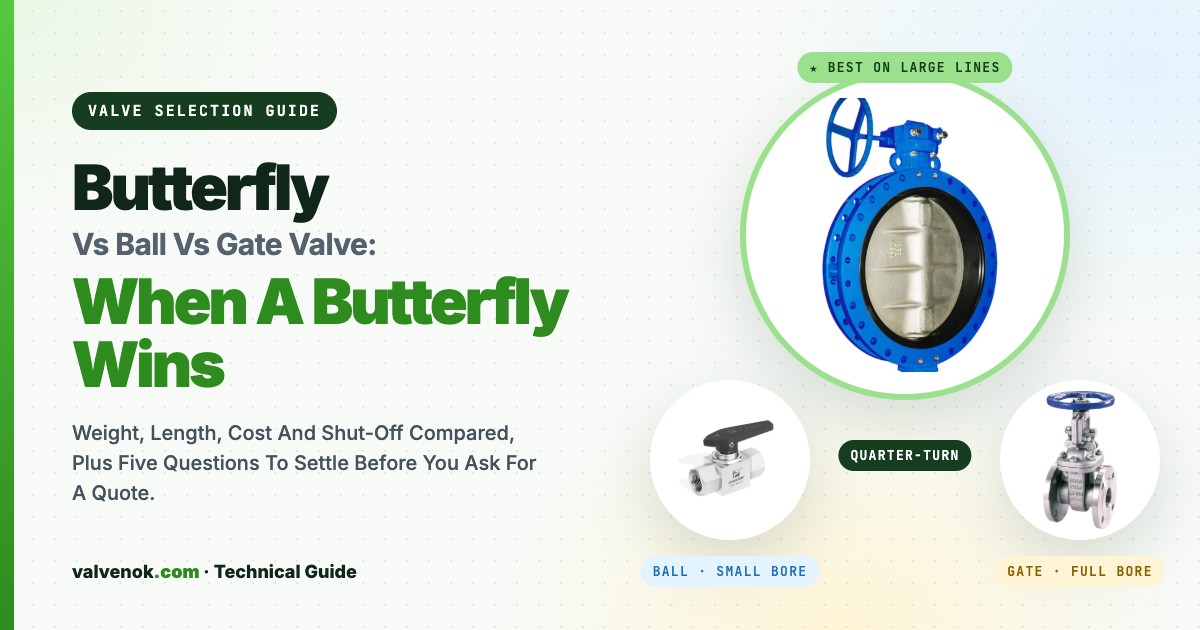
On a large line, the cheapest valve to buy isn't always the cheapest valve to run. When you compare a butterfly valve vs a ball valve vs a gate valve, the right answer depends on the line, not on habit.
Key takeaways
- On large lines, a butterfly valve is usually the lightest, shortest and cheapest of the three.
- Ball valves still win at 2" and below, at high pressure in compact sizes, and where the line must be pigged.
- Gate valves give a full bore but are heavy, tall and slow to operate; some sites still specify them.
- Centric suits water, air and general service; double eccentric and triple offset handle higher pressure, heat and fire-safe duty.
- Settle media, temperature, size, pressure and shut-off before you ask for a quote.
Say you're replacing the isolation valve on a DN300 cooling water line. A gate valve is the traditional choice, a ball valve feels like the safe one, and a butterfly valve is the lightest and shortest of the three. All three will stop the flow. The right choice depends on what the line carries, how hot it runs, the pressure, the space you have, and how tightly the valve has to seal.
This guide compares the three valve types on a real line, explains when to use a butterfly valve (and when not to), and gives you five questions to settle before you ask for a quote.
Butterfly Valve vs Ball Valve vs Gate Valve: How They Compare
| Butterfly valve | Ball valve | Gate valve | |
|---|---|---|---|
| Weight and length at large sizes | Lightest and shortest, as the body is a slim disc between flanges | Heavy and long at large sizes | Heavy and tall, with a long stem |
| Operation | Quarter turn, easy to automate | Quarter turn, easy to automate | Multi-turn, slower to operate |
| Cost at large bore | Usually the lowest | Rises steeply with size | Moderate, but heavy to install |
| Flow path | The disc stays in the flow, causing some pressure drop | Full-bore options with little restriction | Full bore when open |
| Throttling | Suitable for flow control | Some designs only | Not recommended |
| Pigging and solids | Not suitable, as the disc is in the way | Full-bore types can be pigged | Full bore, but solids can stop the gate seating |
In short: above a few inches in diameter, where space, weight and cost matter, a butterfly valve is usually the better choice. Ball and gate valves still win in some situations, covered below. Our guide to ball and gate valves compares those two in more detail.
Quick Guide: Which Valve Should You Choose?
Butterfly Valve Selection: Five Questions to Settle First
Centric vs Double Eccentric vs Triple Offset Butterfly Valves
A centric butterfly valve has the stem through the middle of the disc, which rubs on the seat through part of every stroke. That's fine for water, air and general service. For hot hydrocarbons, steam, high pressure classes or fire-safe duty, offset designs lift the disc off the seat as it opens, which reduces wear and allows metal seats.
| Type | How it works | Typical use | Value Valves range |
|---|---|---|---|
| Centric | Stem through the disc centre; soft seat | Water, air, HVAC, general service | VF-7: DN40 to DN1800, 10 bar standard, 16 bar optional to DN600 |
| Double eccentric | Stem offset behind and to one side of the disc, so it lifts off the seat | Higher pressure, process lines | DN50 to DN1200, ANSI 150 and 300; soft, metal+PTFE or metal seat; API 607 fire safe |
| Triple offset | Double offset plus an angled cone seat, so the disc never rubs | Hot, high pressure, hydrocarbons, fire-safe duty | DN100 to DN1200, ANSI 150, 300 and 600; API 607 fire safe; -100 °C to +760 °C |
Figures are from the Value Valves pages on valvenok.com; the triple offset page has full details.
Worked Example: When to Use a Butterfly Valve on a DN300 Water Line
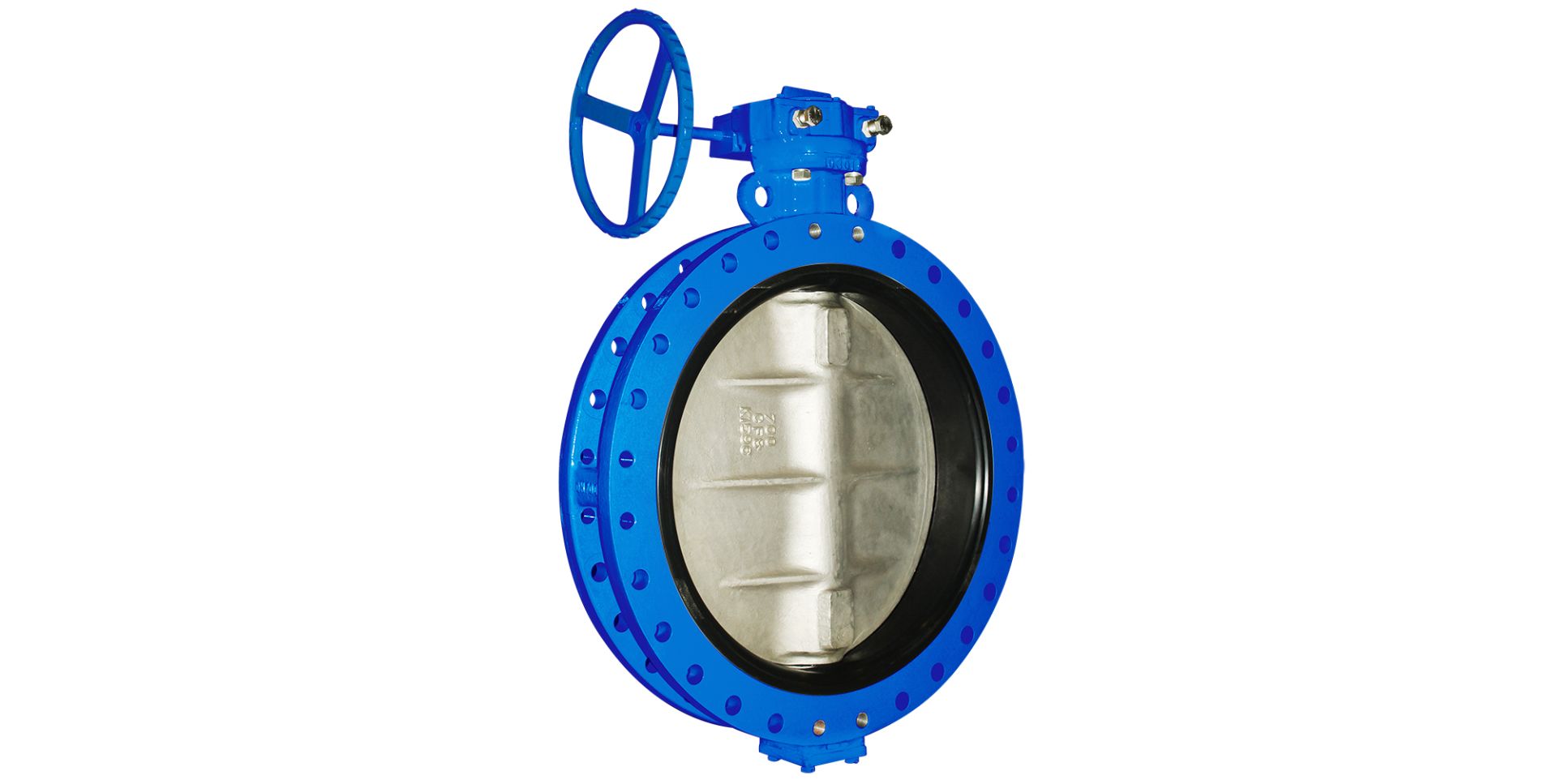
Back to the DN300 cooling water line. Here's how the five questions apply to the Value Valves VF-7 centric range:
| Question | VF-7 centric butterfly valve |
|---|---|
| Media | Soft seat options: NBR, EPDM, EPT, white EPT, neoprene, silicone and FKM. NSF 61 and NSF 372 certified for potable water |
| Temperature | -20 °C to +204 °C across the seat options (each seat material has its own limit) |
| Size | DN40 to DN1800 (1½" to 72"), as wafer (VF-730), lug (VF-733) or flanged (VF-737) |
| Pressure | 10 bar (150 psi) bi-directional bubble-tight as standard; 16 bar (230 psi) on request for DN40 to DN600. Flange drilling to PN10, PN16, ANSI 125/150, BS Table E or JIS 10K |
| Shut-off | Bi-directional bubble-tight shut-off, designed to API 609 and tested to ISO 5208 |
Actuated Butterfly Valve Packages
The VF-7 has an ISO 5211 mounting flange, so a pneumatic or electric actuator bolts straight on. We can supply the valve, actuator, mounting kit and limit switch box as one matched package, ready to install. For what sits around the valve, see our guide to instrumentation around a butterfly valve.
Where Ball and Gate Valves Still Win
- Small lines: at 2" and below, a ball valve is usually simpler and costs about the same.
- Pigging or full-bore flow: a butterfly disc sits in the flow, so use a full-bore ball or gate valve.
- High pressure at small sizes: ball valves handle high pressure classes in compact sizes.
- Infrequent isolation on heavy-duty lines: a gate valve may still be the specified standard on some sites.
Butterfly Valve FAQs
When should you use a butterfly valve instead of a ball valve?
Is a butterfly valve better than a gate valve?
Can a butterfly valve be used for throttling?
What is a triple offset butterfly valve?
Can butterfly valves be automated?
SEND US YOUR LINE DETAILS
Send us the line size, media and pressure, and we'll recommend the right butterfly valve, or tell you if a ball or gate valve suits your line better.
Keep reading
All articles